> ## Documentation Index
> Fetch the complete documentation index at: https://www.integrate.io/docs/llms.txt
> Use this file to discover all available pages before exploring further.
# ETL: EDI (X12) Source
> Configure the EDI (X12) source to read ASC X12 files from file storage, with optional flattening of 834 benefit enrollment files into tabular rows.
The EDI (X12) source reads ASC X12 files from file storage and turns them into rows your pipeline can process. Use it when your files arrive in EDI format, such as 834 benefit enrollment and maintenance files exchanged with health plans and payroll systems.
The component appears as **EDI (X12)** in the source palette. It reads from every file storage connection the [File Storage source](/docs/etl/using-components-file-storage-source) supports: Amazon S3, Google Cloud Storage, Google Cloud Storage v2, Azure Blob Storage, SFTP, FTPS, HDFS, Google Drive, and Google Drive (service account).
You can read files in two ways:
* **Raw X12 segments** - one row per segment, with the envelope control numbers, segment id, and raw elements. Works for any X12 transaction set. You build the shape you need downstream.
* **Enrollment (834) parsing** - the source reads the 834 hierarchy (members and their coverages) and flattens it into tabular rows with named columns such as `member_id`, `last_name`, and `eligibility_begin`. You do not need downstream transformations to get flat enrollment data.
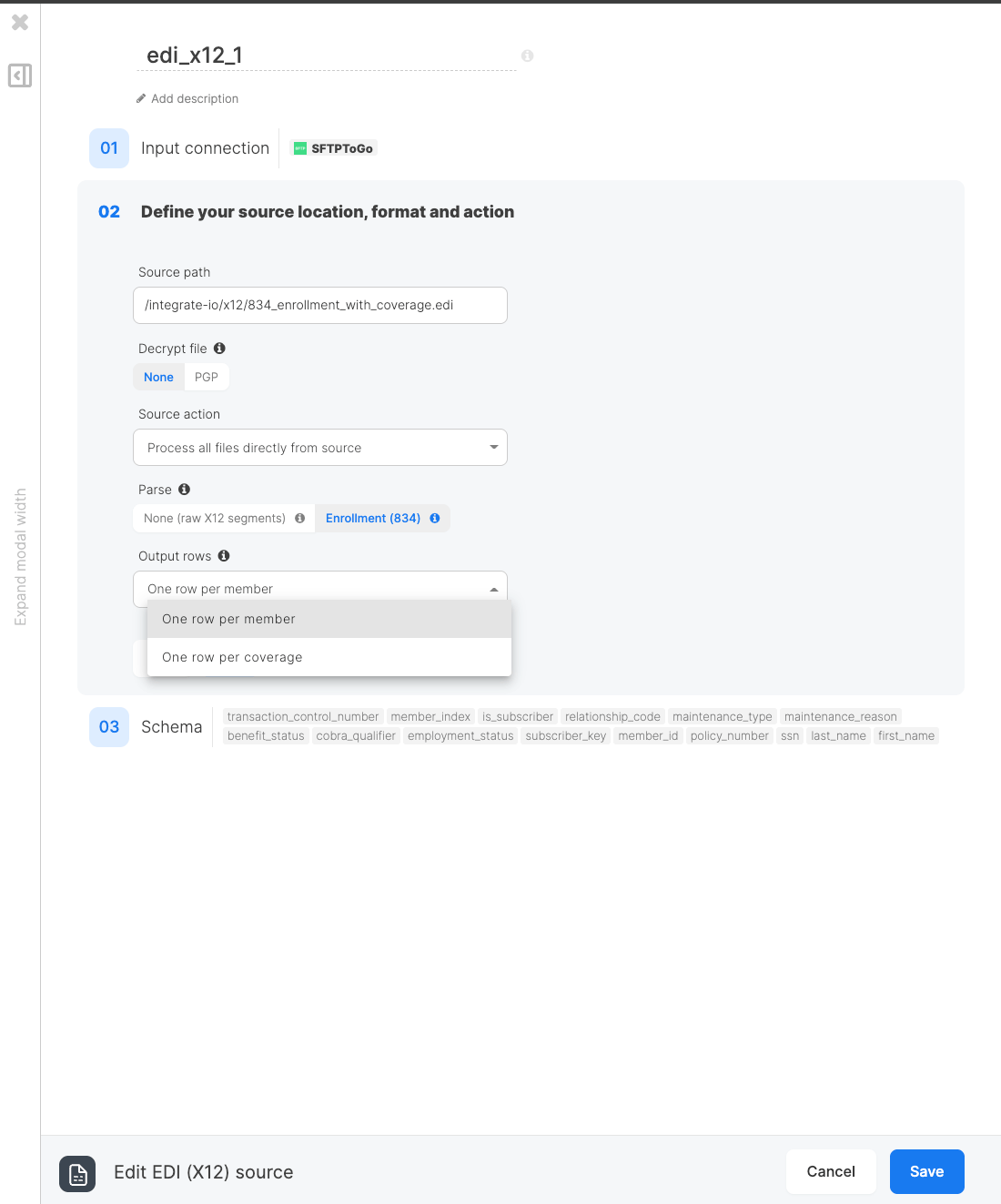 ## Connection
Select an existing file storage connection or create a new one. For more information, see [How to connect to your data sources](/docs/etl/category/connectivity-and-security).
## Source Properties
### Source location
Define the **source bucket** and **source path** the same way as in the [File Storage source](/docs/etl/using-components-file-storage-source#source-location). Pattern globbing is supported.
X12 has no record delimiter setting. Segments are terminated by the character declared in each file's ISA envelope, so the source reads the terminator from the file itself.
The **source path field** option is not available for X12 sources. The interchange, group, and transaction control numbers in each row identify the file of origin instead.
The record type and record settings shown on the File Storage source are hidden here. This component is the X12 format, so there is nothing to choose.
### Decrypt file
If your source files are encrypted with OpenPGP, choose **PGP** and select an active entry from the key dropdown. The entry must hold a private key. Integrate.io decrypts each matching file in memory before parsing it, so the plaintext is never written to storage. See [PGP Keys](/docs/etl/pgp-keys-account-level) for how to add and manage entries.
Leave this on **None** for files that are not encrypted.
### Source action
Choose what happens to each file once it has been read. The options are the same as on the [File Storage source](/docs/etl/using-components-file-storage-source):
* **Process all files directly from source** - the default. Files are read in place and left where they are.
* **Process only new files (Incremental load)** - read only files that have not been processed before. See [Reading File Storage Data Incrementally](/docs/etl/how-do-i-read-data-from-file-storage-incrementally).
* **Copy, merge and process all files** - stage the matching files together before reading them.
* **Move processed files to another folder** - archive each file once the job has read it.
### Parse
The **Parse** setting controls whether the source reads the file as raw segments or interprets its transaction sets first:
* **None (raw X12 segments)** - the default. Each row is one X12 segment, in file order. Nothing is interpreted, so any transaction set reads the same way.
* **Enrollment (834)** - the source reads the 834 benefit enrollment hierarchy and flattens it to tabular rows at the grain you choose below. A file that holds a different transaction set fails the job rather than returning empty output.
### Output rows
When **Parse** is set to **Enrollment (834)**, choose what one output row means:
* **One row per member** - the default. Every member in the file appears exactly once, dependents included. Rows carry the member keys, enrollment status, name, demographics, address, and eligibility window. The `is_subscriber` column tells dependents from subscribers, and `subscriber_key` links a dependent to its subscriber.
* **One row per coverage** - a member enrolled in three plans becomes three rows, and a member enrolled in nothing drops out entirely. Rows carry the member keys plus the plan and its benefit window. Use this grain to count plans; use member rows to count people.
The two grains differ in row count, not just in columns, so choose the one that matches what you want to count downstream.
## How an 834 is read
An 834 is hierarchical: a transaction set is a run of member loops (each opened by an `INS` segment), and each member can hold coverage loops (each opened by an `HD` segment). Dependents follow the subscriber they belong to rather than pointing at them. Flattening walks the file in order and applies these rules, which explain most surprises in the output.
**Members and dependents.** Every `INS` loop becomes a member, dependents included. `is_subscriber` is `Y` for a subscriber and `N` for a dependent, and `subscriber_key` carries the `member_id` of the most recent subscriber, which is how a dependent joins back to the person whose policy covers it. A dependent that appears before any subscriber gets an empty `subscriber_key` rather than being dropped.
**Repeated segments.** Real files repeat things, so:
* Dates take the **last** value. A corrected `DTP*356` later in the loop wins.
* Everything else takes the **first**: the first `REF*0F`, the first `REF*1L`, the first `NM1`, the first `DMG`, the first `N3`, and the first `N4` in a member loop are the ones kept. In 005010X220A1 the first `NM1` is the member's own name loop and the ones after it are the mailing address, employer, school, and custodial parent, so letting those win would overwrite the member's real name, SSN, or address.
**Addresses.** The address is the first `N3` and `N4` anywhere in the member loop, not the address inside the member's own `NM1` loop. A member whose own name loop carries no address but is followed by a mailing-address loop therefore reports the mailing address, which is the only address that member has.
**Missing values are kept, not hidden.** A member with no `REF*0F` still produces a row with an empty `member_id`, because a member with a missing identifier is exactly what a validation step downstream needs to see.
**Segments this component does not model** - `HD` before any `INS`, and loops outside the member and coverage hierarchy - are skipped, and the job log records a warning counter for each kind so you can tell a benign file from an alarming one.
The source reshapes the file; it does not judge it. There is no code-set translation, no plan crosswalk, and no EDI validation. Use downstream transformations for business rules.
## Source Schema
The output schema is fixed by the parse mode and grain. You do not define fields yourself.
The schema step runs the same flattening the job runs, over the same file, so the columns and the sample rows you see while designing are the ones the job produces. Switching **Parse** or **Output rows** changes that shape, so re-run the schema step after changing either.
Very large files are read only as far as the preview needs. The schema step stops once it has enough sample rows, so a multi-gigabyte audit file previews without being read end to end.
### Raw segment columns
With **Parse** set to **None**, each row is one segment with these columns:
| Column | Type | Description |
| ---------------------------- | ------ | ---------------------------------------------- |
| `interchange_control_number` | string | ISA control number of the interchange envelope |
| `group_control_number` | string | GS control number of the functional group |
| `transaction_set_id` | string | Transaction set type, for example `834` |
| `transaction_control_number` | string | ST control number of the transaction set |
| `segment_index` | int | Position of the segment within the file |
| `segment_id` | string | Segment identifier, for example `INS` or `NM1` |
| `element_count` | int | Number of elements in the segment |
| `elem_01` ... `elem_32` | string | The segment's elements, in order |
| `elem_overflow` | string | Any elements beyond the 32nd |
### Member grain columns
With **Enrollment (834)** parsing and **One row per member**:
| Column | Type |
| ---------------------------- | ------ |
| `transaction_control_number` | string |
| `member_index` | int |
| `is_subscriber` | string |
| `relationship_code` | string |
| `maintenance_type` | string |
| `maintenance_reason` | string |
| `benefit_status` | string |
| `cobra_qualifier` | string |
| `employment_status` | string |
| `subscriber_key` | string |
| `member_id` | string |
| `policy_number` | string |
| `ssn` | string |
| `last_name` | string |
| `first_name` | string |
| `middle_name` | string |
| `dob` | string |
| `gender` | string |
| `address_1` | string |
| `address_2` | string |
| `city` | string |
| `state` | string |
| `postal_code` | string |
| `eligibility_begin` | string |
| `eligibility_end` | string |
### Coverage grain columns
With **Enrollment (834)** parsing and **One row per coverage**. A member's coverages are capped at 1000 loops; beyond that the extra loops are not emitted and the job log records a warning. No real enrollment file approaches this, but a truncated or malformed one can.
With **Enrollment (834)** parsing and **One row per coverage**:
| Column | Type |
| ---------------------------- | ------ |
| `transaction_control_number` | string |
| `member_index` | int |
| `coverage_index` | int |
| `subscriber_key` | string |
| `member_id` | string |
| `maintenance_type` | string |
| `insurance_line` | string |
| `plan_coverage_description` | string |
| `coverage_level` | string |
| `benefit_begin` | string |
| `benefit_end` | string |
Date columns such as `dob`, `eligibility_begin`, and `benefit_end` stay strings in the X12 `CCYYMMDD` format. The source reshapes the file rather than interpreting values, so convert dates downstream with [ToDate](/docs/etl/todate) if you need date types.
## Example
Given an 834 file containing one subscriber with dental coverage:
```text theme={null}
ISA*00* *00* *ZZ*SENDER *ZZ*RECEIVER *260801*1200*^*00501*000000101*0*P*:~
GS*BE*SENDER*RECEIVER*20260801*1200*101*X*005010X220A1~
ST*834*0001*005010X220A1~
INS*Y*18*030*XN*A*E**FT~
REF*0F*SUB001~
NM1*IL*1*DOE*JANE****34*123456789~
DMG*D8*19850214*F~
DTP*356*D8*20260101~
HD*030**DEN*DENTAL PLAN*EMP~
DTP*348*D8*20260201~
SE*9*0001~
GE*1*101~
IEA*1*000000101~
```
With **Enrollment (834)** parsing and **One row per member**, the source emits one row (selected columns shown):
| transaction\_control\_number | is\_subscriber | subscriber\_key | last\_name | first\_name | dob | gender | eligibility\_begin |
| ---------------------------- | -------------- | --------------- | ---------- | ----------- | -------- | ------ | ------------------ |
| 0001 | Y | SUB001 | DOE | JANE | 19850214 | F | 20260101 |
`eligibility_begin` comes from the `DTP*356` **before** the `HD` segment, which belongs to the member. The `DTP*348` after the `HD` belongs to the coverage and has no column at this grain, so it does not appear here.
With **One row per coverage**, the same file emits one row per HD loop instead (selected columns shown):
| transaction\_control\_number | subscriber\_key | insurance\_line | plan\_coverage\_description | coverage\_level | benefit\_begin |
| ---------------------------- | --------------- | --------------- | --------------------------- | --------------- | -------------- |
| 0001 | SUB001 | DEN | DENTAL PLAN | EMP | 20260201 |
Here `benefit_begin` is the `DTP*348` inside the `HD` loop. The member's own `DTP*356` has no column at this grain. A member with no `HD` loop at all produces no row here, which is why the two grains can return different row counts for the same file.
## Related
## Connection
Select an existing file storage connection or create a new one. For more information, see [How to connect to your data sources](/docs/etl/category/connectivity-and-security).
## Source Properties
### Source location
Define the **source bucket** and **source path** the same way as in the [File Storage source](/docs/etl/using-components-file-storage-source#source-location). Pattern globbing is supported.
X12 has no record delimiter setting. Segments are terminated by the character declared in each file's ISA envelope, so the source reads the terminator from the file itself.
The **source path field** option is not available for X12 sources. The interchange, group, and transaction control numbers in each row identify the file of origin instead.
The record type and record settings shown on the File Storage source are hidden here. This component is the X12 format, so there is nothing to choose.
### Decrypt file
If your source files are encrypted with OpenPGP, choose **PGP** and select an active entry from the key dropdown. The entry must hold a private key. Integrate.io decrypts each matching file in memory before parsing it, so the plaintext is never written to storage. See [PGP Keys](/docs/etl/pgp-keys-account-level) for how to add and manage entries.
Leave this on **None** for files that are not encrypted.
### Source action
Choose what happens to each file once it has been read. The options are the same as on the [File Storage source](/docs/etl/using-components-file-storage-source):
* **Process all files directly from source** - the default. Files are read in place and left where they are.
* **Process only new files (Incremental load)** - read only files that have not been processed before. See [Reading File Storage Data Incrementally](/docs/etl/how-do-i-read-data-from-file-storage-incrementally).
* **Copy, merge and process all files** - stage the matching files together before reading them.
* **Move processed files to another folder** - archive each file once the job has read it.
### Parse
The **Parse** setting controls whether the source reads the file as raw segments or interprets its transaction sets first:
* **None (raw X12 segments)** - the default. Each row is one X12 segment, in file order. Nothing is interpreted, so any transaction set reads the same way.
* **Enrollment (834)** - the source reads the 834 benefit enrollment hierarchy and flattens it to tabular rows at the grain you choose below. A file that holds a different transaction set fails the job rather than returning empty output.
### Output rows
When **Parse** is set to **Enrollment (834)**, choose what one output row means:
* **One row per member** - the default. Every member in the file appears exactly once, dependents included. Rows carry the member keys, enrollment status, name, demographics, address, and eligibility window. The `is_subscriber` column tells dependents from subscribers, and `subscriber_key` links a dependent to its subscriber.
* **One row per coverage** - a member enrolled in three plans becomes three rows, and a member enrolled in nothing drops out entirely. Rows carry the member keys plus the plan and its benefit window. Use this grain to count plans; use member rows to count people.
The two grains differ in row count, not just in columns, so choose the one that matches what you want to count downstream.
## How an 834 is read
An 834 is hierarchical: a transaction set is a run of member loops (each opened by an `INS` segment), and each member can hold coverage loops (each opened by an `HD` segment). Dependents follow the subscriber they belong to rather than pointing at them. Flattening walks the file in order and applies these rules, which explain most surprises in the output.
**Members and dependents.** Every `INS` loop becomes a member, dependents included. `is_subscriber` is `Y` for a subscriber and `N` for a dependent, and `subscriber_key` carries the `member_id` of the most recent subscriber, which is how a dependent joins back to the person whose policy covers it. A dependent that appears before any subscriber gets an empty `subscriber_key` rather than being dropped.
**Repeated segments.** Real files repeat things, so:
* Dates take the **last** value. A corrected `DTP*356` later in the loop wins.
* Everything else takes the **first**: the first `REF*0F`, the first `REF*1L`, the first `NM1`, the first `DMG`, the first `N3`, and the first `N4` in a member loop are the ones kept. In 005010X220A1 the first `NM1` is the member's own name loop and the ones after it are the mailing address, employer, school, and custodial parent, so letting those win would overwrite the member's real name, SSN, or address.
**Addresses.** The address is the first `N3` and `N4` anywhere in the member loop, not the address inside the member's own `NM1` loop. A member whose own name loop carries no address but is followed by a mailing-address loop therefore reports the mailing address, which is the only address that member has.
**Missing values are kept, not hidden.** A member with no `REF*0F` still produces a row with an empty `member_id`, because a member with a missing identifier is exactly what a validation step downstream needs to see.
**Segments this component does not model** - `HD` before any `INS`, and loops outside the member and coverage hierarchy - are skipped, and the job log records a warning counter for each kind so you can tell a benign file from an alarming one.
The source reshapes the file; it does not judge it. There is no code-set translation, no plan crosswalk, and no EDI validation. Use downstream transformations for business rules.
## Source Schema
The output schema is fixed by the parse mode and grain. You do not define fields yourself.
The schema step runs the same flattening the job runs, over the same file, so the columns and the sample rows you see while designing are the ones the job produces. Switching **Parse** or **Output rows** changes that shape, so re-run the schema step after changing either.
Very large files are read only as far as the preview needs. The schema step stops once it has enough sample rows, so a multi-gigabyte audit file previews without being read end to end.
### Raw segment columns
With **Parse** set to **None**, each row is one segment with these columns:
| Column | Type | Description |
| ---------------------------- | ------ | ---------------------------------------------- |
| `interchange_control_number` | string | ISA control number of the interchange envelope |
| `group_control_number` | string | GS control number of the functional group |
| `transaction_set_id` | string | Transaction set type, for example `834` |
| `transaction_control_number` | string | ST control number of the transaction set |
| `segment_index` | int | Position of the segment within the file |
| `segment_id` | string | Segment identifier, for example `INS` or `NM1` |
| `element_count` | int | Number of elements in the segment |
| `elem_01` ... `elem_32` | string | The segment's elements, in order |
| `elem_overflow` | string | Any elements beyond the 32nd |
### Member grain columns
With **Enrollment (834)** parsing and **One row per member**:
| Column | Type |
| ---------------------------- | ------ |
| `transaction_control_number` | string |
| `member_index` | int |
| `is_subscriber` | string |
| `relationship_code` | string |
| `maintenance_type` | string |
| `maintenance_reason` | string |
| `benefit_status` | string |
| `cobra_qualifier` | string |
| `employment_status` | string |
| `subscriber_key` | string |
| `member_id` | string |
| `policy_number` | string |
| `ssn` | string |
| `last_name` | string |
| `first_name` | string |
| `middle_name` | string |
| `dob` | string |
| `gender` | string |
| `address_1` | string |
| `address_2` | string |
| `city` | string |
| `state` | string |
| `postal_code` | string |
| `eligibility_begin` | string |
| `eligibility_end` | string |
### Coverage grain columns
With **Enrollment (834)** parsing and **One row per coverage**. A member's coverages are capped at 1000 loops; beyond that the extra loops are not emitted and the job log records a warning. No real enrollment file approaches this, but a truncated or malformed one can.
With **Enrollment (834)** parsing and **One row per coverage**:
| Column | Type |
| ---------------------------- | ------ |
| `transaction_control_number` | string |
| `member_index` | int |
| `coverage_index` | int |
| `subscriber_key` | string |
| `member_id` | string |
| `maintenance_type` | string |
| `insurance_line` | string |
| `plan_coverage_description` | string |
| `coverage_level` | string |
| `benefit_begin` | string |
| `benefit_end` | string |
Date columns such as `dob`, `eligibility_begin`, and `benefit_end` stay strings in the X12 `CCYYMMDD` format. The source reshapes the file rather than interpreting values, so convert dates downstream with [ToDate](/docs/etl/todate) if you need date types.
## Example
Given an 834 file containing one subscriber with dental coverage:
```text theme={null}
ISA*00* *00* *ZZ*SENDER *ZZ*RECEIVER *260801*1200*^*00501*000000101*0*P*:~
GS*BE*SENDER*RECEIVER*20260801*1200*101*X*005010X220A1~
ST*834*0001*005010X220A1~
INS*Y*18*030*XN*A*E**FT~
REF*0F*SUB001~
NM1*IL*1*DOE*JANE****34*123456789~
DMG*D8*19850214*F~
DTP*356*D8*20260101~
HD*030**DEN*DENTAL PLAN*EMP~
DTP*348*D8*20260201~
SE*9*0001~
GE*1*101~
IEA*1*000000101~
```
With **Enrollment (834)** parsing and **One row per member**, the source emits one row (selected columns shown):
| transaction\_control\_number | is\_subscriber | subscriber\_key | last\_name | first\_name | dob | gender | eligibility\_begin |
| ---------------------------- | -------------- | --------------- | ---------- | ----------- | -------- | ------ | ------------------ |
| 0001 | Y | SUB001 | DOE | JANE | 19850214 | F | 20260101 |
`eligibility_begin` comes from the `DTP*356` **before** the `HD` segment, which belongs to the member. The `DTP*348` after the `HD` belongs to the coverage and has no column at this grain, so it does not appear here.
With **One row per coverage**, the same file emits one row per HD loop instead (selected columns shown):
| transaction\_control\_number | subscriber\_key | insurance\_line | plan\_coverage\_description | coverage\_level | benefit\_begin |
| ---------------------------- | --------------- | --------------- | --------------------------- | --------------- | -------------- |
| 0001 | SUB001 | DEN | DENTAL PLAN | EMP | 20260201 |
Here `benefit_begin` is the `DTP*348` inside the `HD` loop. The member's own `DTP*356` has no column at this grain. A member with no `HD` loop at all produces no row here, which is why the two grains can return different row counts for the same file.
## Related